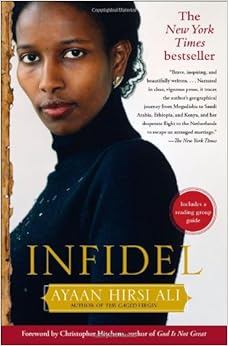
Ayaan Hirsi Ali, pictured above, is an employee of the American Enterprise Institute, a think tank designed:
"to defend the principles and improve the institutions of American freedom and democratic capitalism—limited government, private enterprise, individual liberty and responsibility, vigilant and effective defense and foreign policies, political accountability, and open debate"
Her political career in the US is only the latest chapter of an incredibly long international journey that began in 1969 in Mogadishu, Somalia. The child of a deeply religious traditionalist mother and a politically powerful reactionist father (a leading figure of the Somali revolution) she was often torn between the high demands of her clan and an educated understanding of her human rights.
She bounced back and forth between a strict adherence to the burkha and a rebellious pre-marital relationship, an obedient submission to her physically abusive mother and a hidden collection of Western literature. She bounced around geographically as well, her family forced to flee Somalia due to her father's prominence in the fight against the country's military dictator Major General Mohamed Siad Barre. She grew up exposed to all sorts of variations on Islamic and African life – extremist Islam in Saudi Arabia, intolerant anti-Islamic sentiment in Ethiopia, to a comfortable upperclass life in Nairobi, Kenya.
Her childhood, charmed by the wealth and resources of her important father, was decorated with both religious and academic education. While the girls at her school in Nairobi steadily abandoned their education for marriage, Ayaan developed the conviction to avoid this fate, to not simply marry the much older gentleman her father selects for her and raise his children as one of his many wives and run his house. Her decision brought her, against the strong will of her clan, to the Netherlands, where she requested political asylum to escape the clan members who pursued her.
She received a residence permit within three weeks of arriving in the Netherlands, although it was typical for applicants at the time to have to wait eight months for a decision. How? She had the gift of education. She knew how to frame her story to appeal to the powers that be, to concoct a story of danger, real physical need for asylum. The gatekeepers of the Netherlands (a country with a far more liberal border than most) can only allow for so many political refugee immigrants. Like Okwe and Senay in Dirty Pretty Things, Ayaan developed the identity that was expected of her. While not in direct danger, Ayaan did face a life of oppression underneath a husband she didn't want. It does not meet the standards of an immigration council who is trying to protect hunted individuals from death. However, Ayaan was able to play the system.
Unlike Okwe and Senay, who had truly dangerous circumstances awaiting them in their original countries and seemingly no hope for upward mobility or even personal security in their host country of Britain, Ayaan did manage to enter herself into the education system of the Netherlands, and eventually into the political spectrum. Ayaan became a member of the Dutch parliament acting as a resource for female empowerment and the injection of human rights into traditional clan Islam's treatment of women.
Her memoire is a fascinating bildungsroman about the journey of an oppressed girl over the obstacles of tradition and the laws of immigration to her free, empowered, adult womanhood.
Her memoire is a fascinating bildungsroman about the journey of an oppressed girl over the obstacles of tradition and the laws of immigration to her free, empowered, adult womanhood.

No comments:
Post a Comment